Andrea Sáenz de Viteri: Political Leaders Favor Their Home Regions
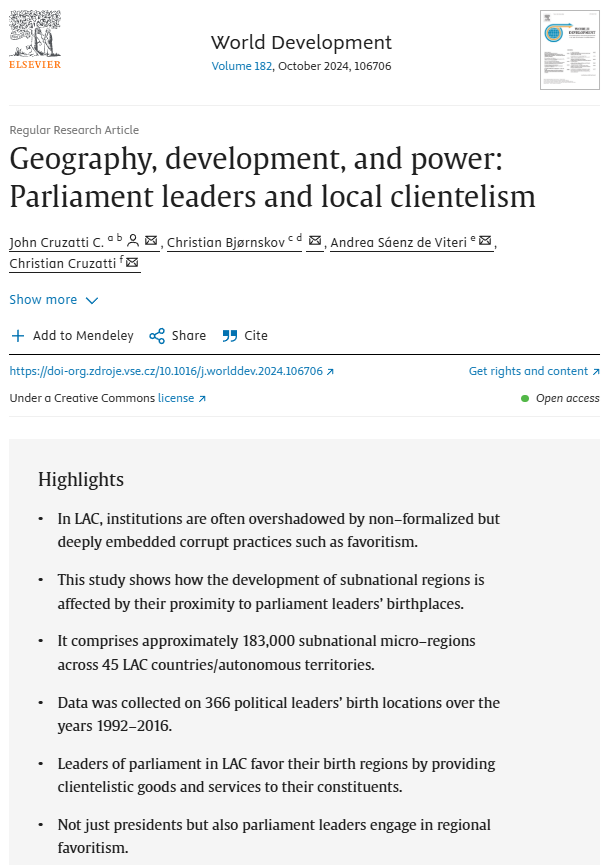
Do political leaders direct more resources toward the places they come from? The article “Geography, development, and power: Parliament leaders and local clientelism,” published in World Development, shows that parliamentary leaders can influence the development of regions located near their birthplaces.
The research compares regions’ proximity to parliamentary leaders’ birthplaces with indicators of local development, including nighttime light emissions and the distribution of World Bank aid. The results show that regions closer to leaders’ birthplaces tend to benefit more while those leaders are in office.
Andrea Sáenz de Viteri and her coauthors created a novel dataset combining information on the birthplaces of 366 parliamentary leaders between 1992 and 2016 with data covering approximately 183,000 local regions across 45 Latin American and Caribbean countries and territories.
The findings suggest that parliamentary leaders (not only presidents) may use their political influence to favor their home regions through the allocation of public resources, goods, and services. This pattern is particularly evident where formal institutions are weaker and political favoritism is more difficult to control.
Other findings include:
-
Political favoritism can affect development even at a highly local level.
-
Regions close to leaders’ birthplaces receive more World Bank aid and show higher levels of nighttime light activity.
-
Institutional weakness makes this form of regional favoritism more likely.
The full article was published in World Development, Volume 182, in October 2024. You can find the full version >>> here <<< .