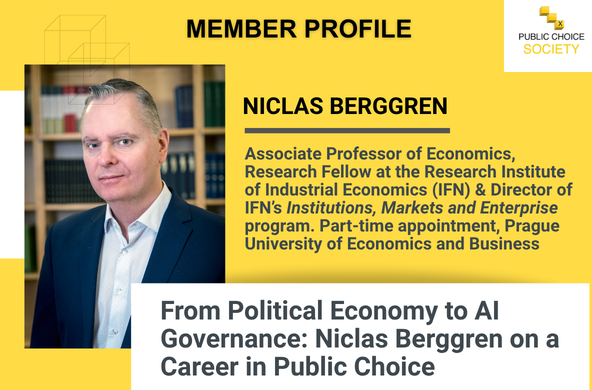
Niclas Berggren: From Political Economy to AI Governance
The Public Choice Society has published a profile of Niclas Berggren, who works at the Research Institute of Industrial Economics (IFN) in Stockholm and also at the Prague University of Economics and Business. The article traces his nearly three decades in public choice and his current research on the governance of AI in science.
From financial trading to public choice
Berggren enrolled at the Stockholm School of Economics intending to become a financial trader. A course in institutional economics and James Buchanan and Geoffrey Brennan’s The Reason of Rules, however, drew him to public choice. A Fulbright scholarship took him to George Mason University in 1993–1994, where he studied with James Buchanan and Robert Tollison. He still names Buchanan as the scholar who influenced him most. His research has since expanded to economic freedom, culture, trust, tolerance and religion.
Why scientists may resist AI tools
The article discusses in detail Berggren’s study An Interest-Group Theory of AI-Tool Governance in Science, published in Public Choice. AI can raise scientific productivity, but it does not benefit all researchers equally. Those who gain less may push for restrictions to protect their relative standing in academic careers. Berggren models this conflict as a Tullock contest, in which groups spend resources to influence the rules. Restrictions can therefore emerge even when AI benefits society as a whole. As Berggren puts it, “we shouldn’t accept stated justifications for regulations at face value.”
Advice for early-career researchers
He encourages young scholars to attend conferences, gather feedback, practise presenting and build networks of co-authors and friends. He favours smaller, specialised meetings over large general-interest conferences.
Read the full article on the Public Choice Society website.