Lucie Mařanová and Marek Hudík: How Economic Reforms Gave Rise to Small Nations
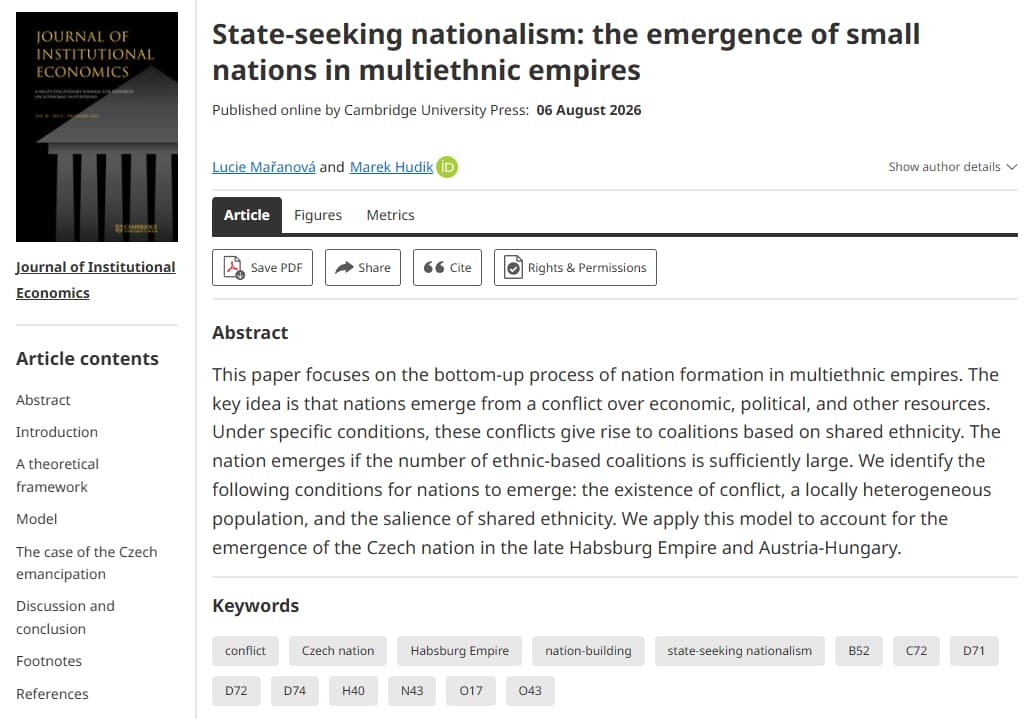
Why did small nations emerge within multiethnic empires such as the Habsburg Monarchy, where ruling elites had no interest in fostering national identity? A study by Lucie Mařanová and Marek Hudík from the Faculty of Business Administration at the Prague University of Economics and Business, published in the Journal of Institutional Economics, offers an answer. It shows that nation formation can be an unintended consequence of reforms aimed at economic growth.
Nation-Building from Below
Research on nationalism has mostly examined nation-building from the top down, as a process in which states deliberately build a national identity among their populations. This framework has difficulty explaining “state-seeking” nationalism: the emergence of small, subordinate nations within multiethnic empires such as the Habsburg or Ottoman Empires. The study State-seeking nationalism: the emergence of small nations in multiethnic empires examines this process from below. Its central argument is that nations emerge from a conflict over economic, political, and other resources.
Three Conditions for the Emergence of a Nation
According to the authors, the process requires the existence of conflict, a locally heterogeneous population, and the salience of shared ethnicity. The conflict concerns access to markets, credit, education, and administrative positions.
When sovereigns liberalise institutions to raise output and tax revenue, they reduce barriers to migration and market entry, bringing previously separated groups into direct competition. In this situation, shared ethnicity can serve as a focal point for coordination and exclusion, allowing individuals to form coalitions that exclude others. A nation emerges once the number of such ethnic-based coalitions crosses a threshold.
The Czech Case: From Reform to Competition
The authors combine a formal model with a historical analysis of the Czech Lands. Geopolitical shocks weakened the Empire’s fiscal and economic position, notably the loss of much of Silesia in the mid-eighteenth century and the disruptions of the Continental Blockade. The loss of Silesia also shifted the Empire’s economic centre of gravity towards the Czech Lands.
The reforms that followed included the Theresian and Josephine reforms, the abolition of serfdom in 1848, constitutional reform, the Trades License Regulation, and the dismantling of guild privileges. These reforms raised economic output. However, they also brought Czech-speaking migrants from rural areas into cities previously dominated by German speakers, where both groups now competed for jobs, credit, and administrative posts.
Savings Banks, Associations and Language
Ethnic coalitions subsequently formed across several domains. Established German and Jewish banks primarily served large, incumbent firms, so Czech actors founded their own savings banks, which channelled funds to Czech entrepreneurs. Professional associations, although sometimes formally open to all, increasingly operated along ethnic lines. Language regulations adopted in 1880 and 1897 granted Czech formal equality with German in official communication. National mobilisation was strongest in economically developed and culturally mixed regions.
Nation as a By-product of Reform
The study concludes that nation formation in cases of this kind is a by-product of growth-oriented reform rather than its objective.
The framework is not limited to the Czech case. It applies more broadly to situations that combine multiethnic populations, institutional or economic change that increases interaction and competition, and pre-existing cultural distinctions. The model identifies the conditions under which national mobilisation is more likely to be effective, and it thus complements accounts that emphasise agency. It also offers a broader lesson for institutional economics: reforms may produce social and political consequences that go well beyond their intended economic goals.
Mařanová, L., & Hudik, M. (2026). State-seeking nationalism: the emergence of small nations in multiethnic empires. Journal of Institutional Economics, 22, e39, 1–16. https://doi.org/10.1017/S1744137426100770 (Open Access)